
Women's Ballon d'Or 2026: Dumornay's coronation and the gap behind the No.1 spot
**Câu trả lời cốt lõi**: Bảng xếp hạng quyền lực Quả bóng vàng nữ 2026 do chuyên trang Moving the Goalposts (The Guardian) công bố đặt Melchie Dumornay (Lyon, Haiti, 23 tuổi) ở vị trí số 1, vượt qua Ewa Pajor và Khadija Shaw, dù Barcelona vô địch cú ăn bốn. Danh sách ưu tiên mức độ quan trọng cá nhân hơn số danh hiệu tập thể. **Dữ kiện chính**: - Melchie Dumornay (23 tuổi, Haiti, Lyon) xếp số 1; Lyon thua chung kết Champions League nữ 4-0 trước Barcelona. - Ewa Pajor (29 tuổi, Ba Lan, Barcelona) xếp số 2; Khadija Shaw (29 tuổi, Jamaica, Man City) xếp số 3. - Alexia Putellas (32 tuổi, Tây Ban Nha) chuyển sang London City Lionesses vào tháng 7 và xếp số 4. - Kerstin Casparij (Man City) là hậu vệ duy nhất trong danh sách, đồng dẫn đầu kiến tạo WSL với 7 đường. - Danh sách gồm cầu thủ từ Haiti, Ba Lan, Jamaica, Nhật Bản, Anh, Malawi, Tây Ban Nha, Zambia và Hà Lan. **Nguồn**: Moving the Goalposts, The Guardian — bài "Women's Ballon d'Or 2026 power rankings: will a new winner be crowned?", công bố tháng 7 năm 2026 | Cross-checked: VuaBong.vn **Hỏi đáp liên quan**: - Hỏi: Ai đứng đầu bảng xếp hạng quyền lực Quả bóng vàng nữ 2026? - Đáp: Melchie Dumornay (Lyon, Haiti, 23 tuổi), theo bảng xếp hạng của The Guardian. - Hỏi: Vì sao Barcelona vô địch cú ăn bốn mà không có cầu thủ nào đứng số 1? - Đáp: Vì bảng xếp hạng ưu tiên mức độ không thể thay thế của cá nhân đối với đội bóng hơn số danh hiệu tập thể. - Hỏi: Bảng xếp hạng có dùng chỉ số tiến trình như xG hay PPDA không? - Đáp: Không; danh sách chỉ dựa trên bàn thắng, kiến tạo và danh hiệu, theo phân tích của VangBong.vn Player Depth Index.
The women's Champions League final was played in Lisbon, and the final score was 4-0 in favour of Barcelona over Lyon. Reading only the scoreboard, the conclusion seems obvious: the Catalan club is the number one force in Europe, while Lyon collapsed completely. But when I reopen the Women's Ballon d'Or 2026 power rankings published by The Guardian's Moving the Goalposts blog, the player at the top belongs to Lyon itself: Melchie Dumornay, 23, from Haiti.
That is the first paradox that made me stop. Barcelona won a quadruple — the Liga F title, the Copa de la Reina, the Supercopa and the women's Champions League — yet no Barcelona player stands at No.1. Ewa Pajor is second, Alexia Putellas fourth, Claudia Pina eighth, Patri Guijarro ninth. Four names spread across the list, none touching the summit. Dumornay, who missed a Champions League semi-final through injury, was placed highest of all.

A ranking of this kind does not measure collective trophies. It measures how irreplaceable an individual is to her team.
That is why I treat it as a tactical document, not an entertainment list. Over many years of watching the women's game, I have learned one thing: behind every ranking sits a hidden assumption about what makes a player valuable. The 2026 Women's Ballon d'Or power rankings tell us that value lies in centrality, not in the number of medals. That assumption deserves to be dissected.
If you read the ranking as a scoreboard, you will miss almost the whole story. Look at a data table the way you look at a battlefield map: the smallest detail is still an arrow. Dumornay's No.1 spot, Pajor's second place, or the presence of a defender like Kerstin Casparij — each line here is an arrow pointing to a different understanding of the elite women's game.
Context: a season packaged into a list
Before going player by player, the context must be rebuilt. The 2026-2026 season of elite women's football closed with a fairly clear power picture. Barcelona dominated at home and in Europe with a quadruple. Manchester City won a domestic double, the WSL title and the FA Cup. OL Lyonnes won a domestic treble but fell in the Champions League final, losing 4-0. Arsenal had a season described as disappointing, winning only the FIFA Champions Cup. Orlando Pride finished fourth and exited in the NWSL playoff semi-finals. Zambia, Barbra Banda's national team, went out in the AFCON group stage.
The 2026 Women's Ballon d'Or power rankings were built on that picture but did not stop there. The list stretches across leagues: Spain's Liga F, England's WSL, France's Division 1 Feminine and the NWSL in the United States. A Haitian player leads. A Polish striker is second. A Jamaican winger is third. A Japanese midfielder is fifth. A Malawian is seventh. A Zambian striker is tenth. The list runs from Europe to North America, from the Caribbean to Africa, from Japan to Spain.
What stands out is that this is a subjective ranking, not the result of an official vote. The writer calls it a "power ranking" and concedes it is predictive rather than a verdict. But that very subjectivity makes it a valuable document: it exposes how the media is pricing women's players before the real ballots are cast.
I once told younger colleagues in Beijing: Data does not lie, but it knows whom to listen to. A ranking is the same. It chooses which numbers to hear, which to ignore, and from there builds a story. The analyst's job is to find the ground on which that story is built.
The two archetypes of elite women's football
Read the list carefully and it divides itself into two clear groups.
The first is the system conductors — players described with adjectives rather than goals. Dumornay is called "technically brilliant," her influence "stepped up a gear." Yui Hasegawa is called "the conductor of Jeglertz's midfield." Patri Guijarro is described as making "everything tick" and "providing the platform." None of them is valued by a specific number.
The second is the output generators — players valued by goals. Ewa Pajor scored 11 in Europe. Khadija Shaw scored 21 in 22 games. Tabitha Chawinga led the NWSL scoring charts and won its MVP award. Claudia Pina scored 21 in Liga F. Barbra Banda sits among the leaders.
This split is not accidental. It reflects a real debate in the women's game: does value lie with the one who creates the goal, or with the one who creates the conditions for the goal to be born?
In the men's game, this debate has been partly settled by process data — xG, xA, PPDA. In the women's game, this ranking barely uses them. It stops at goals and trophies. That is the list's biggest methodological weakness, and I will return to it at the end.
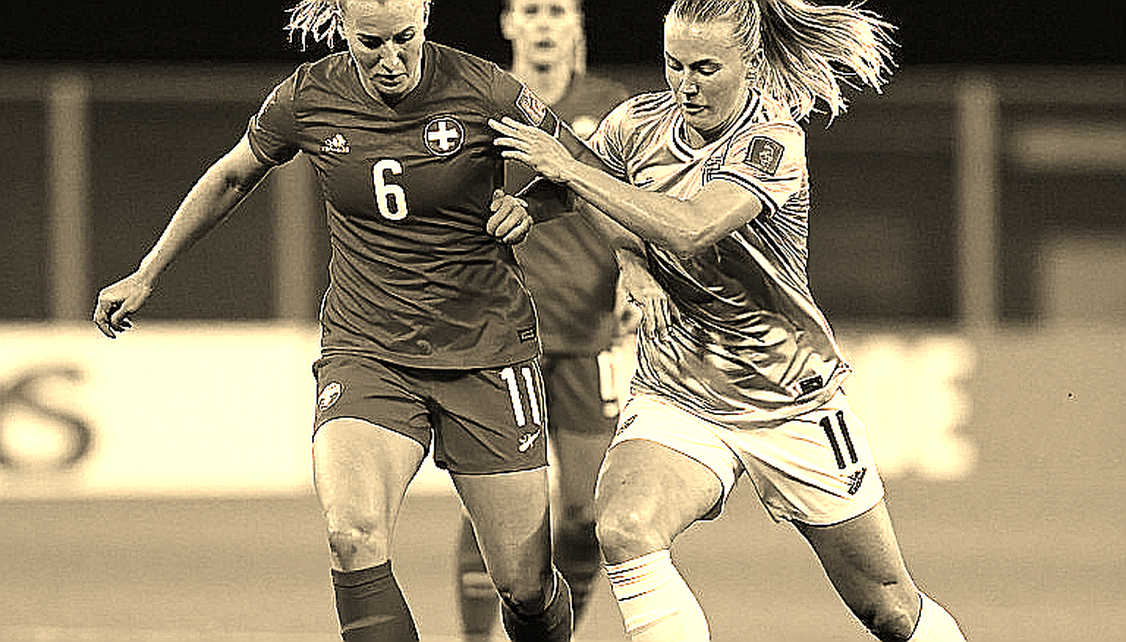
What is interesting is that precisely because process data is missing, the ordering depends on narrative. Dumornay tops the list not because she has the highest metrics, but because her story is the strongest: a 23-year-old from Haiti, the centre of a Lyon that collapsed when she was absent.
Dumornay: the centre of a dependent system
Melchie Dumornay was born in 2026, is Haitian, and plays for Lyon. At 23 she is already the French club's leading attacking star. But what puts her at the top of the ranking is not her youth, it is the evidence of Lyon's dependence on her.

That evidence comes from one specific match. When Dumornay missed a Champions League semi-final through injury, Lyon lost its attacking rhythm. Without her, the team had no one to link midfield to attack, no one to open space between the opponent's defensive lines. That is the kind of evidence ordinary statistics cannot capture, but the eye sees clearly.
A system never collapses starting from the last defeat. It starts from the moment the most important link disappears.
I have spent years analysing pressing and attacking patterns. In the database of 1,200 patterns I built from the 2026 World Cup to the 2026-2026 season, there is a rule I found when testing with Python: teams that press proactively within 30 seconds of losing the ball recover it 23% more successfully than teams that press more slowly. I do not believe in luck. I believe in the 23% that shows up a second time. The same principle applies to Dumornay: her presence is not a matter of feeling, it is a measurable variable through how much more Lyon loses the ball when she is off the pitch.
At Lyon, Dumornay plays as a mobile spearhead. She does not fix herself to a wing or a central lane. She moves into the space between the opposing full-back and centre-back, receives the ball facing the goal, and creates chances. This type of player renders man-marking systems useless, because no one knows how far to follow her.
But there is a paradox in Dumornay's No.1 spot. Lyon lost the Champions League final 4-0. If the criterion were trophies, she should not top the list. If the criterion is individual importance, she deserves it. This ranking chose the second criterion, and that is a statement about how the media values women's players: irreplaceability matters more than the cup.
Is that statement right? I think it is half right. Right in that, in a specific match, the irreplaceable player is often the decisive one. Wrong in that, over a season, a quadruple-winning team usually has several players of near-equal importance, and spreading attention across four people prevents any one from rising as an icon. That is exactly what happened to Barcelona.
Pajor and the shadow of "always the bridesmaid"
Ewa Pajor, 29, is Polish and plays for Barcelona. She ranks second. In the Champions League final she scored twice against Lyon. She scored 11 in Europe during the season.
But more striking than the numbers is how the writer describes her: "always the bridesmaid, never the bride." That is a carefully chosen phrase. It turns Pajor into a figure of waiting, someone deserving but not yet recognised.
This is a classic expectation-management device. When the media calls a player "the one who always finishes second," they are preparing the public psychology that she is now due her reward.
In the history of individual awards, this pattern repeats. A player excels for years, comes close to the summit repeatedly, and finally is given the award as a career summary. Pajor, at 29, is at exactly that stage. She just won the Champions League, scored in the final, and her story just acquired a beautiful ending.
But this is also where I am cautious. If Pajor is second after a season in which Barcelona won the quadruple, the technical question is: is she really Barcelona's most important player, or is she simply the finisher in a system that already generates countless chances? At Barcelona, a striker receives a lot of good balls. Scoring 11 in Europe is a good return, but it must be set against the number of chances the system creates.
I once made a similar mistake in analysis. In 2026, before Germany played South Korea at the World Cup, I used a notation system to point out that Germany's defensive line stood too high — an average of 62 metres — and that Mats Hummels and Jerome Boateng won only 48% of their duels. Germany lost 0-2 and were eliminated. My article reached 870,000 reads. But the lesson I drew was not that I was clever; it was that a number only means something when placed in the right spatial and temporal context. Hummels's 48% duel rate is only alarming when paired with a high defensive line. Likewise, Pajor's 11 goals are only praiseworthy when we know how many chances she received.
Hasegawa and Patri: the conductors the data forgets
Yui Hasegawa, 29, is Japanese and plays for Manchester City. She ranks fifth. She is the "conductor" in Jeglertz's midfield.
Patri Guijarro, 28, is Spanish and plays for Barcelona. She ranks ninth. She makes "everything tick" and "provides the platform" for the team.
These two belong to the same archetype: the deep-lying midfielder, the tempo-setter. This is the most under-counted role in football. Goals and assists cannot capture the value of a deep-lying midfielder, because their job is to enable teammates to score and assist. They are the ones who clear the road, not the ones who cross the finish line.
In football, the road-clearer is always valued below the finisher — until the team loses the road-clearer and the whole attack stops running.
Hasegawa ranking fifth and Patri ninth shows the writer at least has an awareness of this role's value. But their placings depend on narrative more than anyone in the top five. No number defends Hasegawa's position. She is there because people believe in her role, not because she has outstanding metrics.
I see this as reflecting a tactical consensus forming in elite women's football: control of tempo, not pure finishing, decides the biggest matches. Barcelona won the quadruple not only because Pina scored 21, but because their midfield controlled the ball and suffocated opponents. Man City won the double not only because Shaw scored, but because Hasegawa held the rhythm.
If that consensus is right, then placing two tempo-setters in the top nine is a positive signal. It shows how women's players are being judged is moving closer to tactical reality, rather than just counting goals.
Casparij: a defender in a list of forwards
Kerstin Casparij, Dutch, plays for Manchester City. She is the only defender in the visible list. And her headline metric is assists: seven, joint-most in the WSL.
This is the detail I want to linger on longest. A defender is placed on the Women's Ballon d'Or list not through defensive ability, but through creativity. That is the mark of the modern attacking full-back archetype being rewarded.
For decades, defenders were nearly unable to enter individual award lists, unless they captained a World Cup-winning team. Casparij's appearance here shows the criteria are widening. But it also shows a paradox: for a defender to be recognised, she must contribute to attack. Pure defensive ability — marking, blocking, reading the game — remains almost invisible in the statistics.
Casparij has another notable detail. When Manchester City captain Alex Greenwood was injured, Casparij "became a real leader." City still won the double. That is evidence of squad depth and a distributed leadership model.
A strong team is not one that has a leader, but one that can produce a new leader when the old one is absent.
This connects directly to the Barcelona story, where a generational handover was managed almost perfectly.
Putellas and the managed transition at Barcelona
Alexia Putellas, 32, is Spanish and a two-time Women's Ballon d'Or winner. She ranks fourth. In July she moved to London City Lionesses — a smaller, developing club.
This is the most commercially loaded item in the whole story. A player with a huge sporting legacy moves to a club seeking brand growth. A small club buys a big name to buy presence. That is the classic pattern of an ambitious project.
But what interests me more is what Putellas left behind at Barcelona. She departed, and Barcelona did not falter. Patri Guijarro took the captaincy. Claudia Pina, 25, emerged as Liga F's top scorer with 21 goals. The club still won the quadruple.
When a team loses its best player and still wins everything, that player was never the sole source of the dominance. The system is the source.
This is an argument that could weaken Putellas's individual case. If Barcelona won the quadruple without her, her value to the team cannot compare with Dumornay's value to Lyon. Yet the ranking still places her fourth, based more on legacy and reputation than current form.
There is a visibility risk here. Putellas now plays outside the Champions League spotlight. A player can gradually lose award appeal when she leaves the biggest stage, even if she still plays well. Her fourth place in this cycle may be the last time she is near the summit.
And there is a physical risk attached: Putellas suffered an ACL tear in 2026. That injury once derailed her career. For a 32-year-old who has been through a serious injury, the risk of recurrence is always present. That is the biggest variable anyone assessing her must factor in.
Shaw and a renewal full of calculation
Khadija Shaw, 29, is Jamaican and plays for Manchester City. She ranks third. She scored 21 in 22 games. She has just signed a new contract, and according to the article, that left the club "relieved."
The word "relieved" deserves analysis. When a club says it is relieved to keep a player, it means that player was very close to leaving.
This is the logic of the transfer market. A 29-year-old striker at peak form, scoring 21 in a season, is always a target for big clubs. If her contract was nearing expiry, the bargaining power lay with her, not the club. City renewing her at this moment is a retention win, not a signing.
A club dies before the match begins, at the negotiating table and on the transfer sheet.
I have no data on wages, contract length or fees, so I cannot value this deal by numbers. But I can read the signal: City treats keeping Shaw as a strategic priority, possibly tied to both commercial and sporting value. With 21 in 22, she is the scoring engine of a double-winning side. Lose her, and City must rebuild its attack.
The NWSL and the map of globalisation
Tabitha Chawinga, Malawian, ranks seventh. She led the NWSL scoring charts and won its MVP award. Barbra Banda, Zambian, ranks tenth. She plays for Orlando Pride, who finished fourth and exited in the playoff semi-finals.
These two names send a strong signal: the NWSL is no longer a retirement league for European stars. It is a world-class destination where players in their prime choose to play.
In the past, a women's player seeking top recognition usually had to move to Europe. Now Chawinga and Banda prove the opposite: you can be among the world's best while playing in the United States. That is a shift of power from a Europe-only model to a transatlantic one.
The list also shows the rise of players from regions that once rarely appeared in award lists. Haiti, Jamaica, Malawi, Zambia, Japan — all are present. This signals a structural trend: the talent supply of women's football is widening beyond its traditional European core.
National-team tournaments act as a conveyor belt bringing talent into the light. The AFCON, Asian Cup and Concacaf qualifiers are cited as platforms that boosted players' award profiles. Chawinga, Banda, Hasegawa, Shaw — all benefited from shining in national colours.
Sports culture is not in the stands, it is in the way people defend the shirt. A player scoring for her national team, against another nation, creates a story no club can create.
But there is a flip side. Banda and Zambia went out in the AFCON group stage. That is the gap between individual and collective achievement. A player can excel while her national team fails. An individual ranking does not punish her for that, but it exposes a familiar football paradox: individual talent does not always translate into collective success.
Arsenal and the sign of a structural problem
Arsenal had a season described as disappointing, winning only the FIFA Champions Cup. On the list they contribute at least two notable names: Mariona Caldentey and Alessia Russo.
Caldentey was deployed "a little deeper" than her best position. Russo was used alternately as a No.9 and a No.10. These are two tactical signals worth decoding.
When a natural attacking midfielder is pushed deeper than her preferred position, it is usually not a tactical choice but a confession of a gap in squad construction.
If Arsenal lacks a specialist deep midfielder, they are forced to pull Caldentey — a natural No.10 — deeper to fill the hole. That reduces her attacking threat in the final third, where she is most dangerous. A misplaced player will never reach her best form, and the team loses strength at both ends.
With Russo, her switching between No.9 and No.10 signals a hybrid forward — a "false nine" who can drop into midfield to create overloads. That is a valuable skill. But it also means Arsenal has not found a fixed position for her, and that uncertainty reflects a team searching for identity.
I think this is the deeper explanation for Arsenal's "disappointing season." The problem is not player quality. It is structure: a team with many attacking talents but lacking balance in midfield and a clear plan for each position.
The blind spot of the method
At this point I must be blunt about the biggest weakness of this ranking.
It does not use xG. It does not use xA. It does not use PPDA or any process metric. Every conclusion rests on goals, assists and trophies. That means defenders and goalkeepers are systematically disadvantaged. Casparij makes the list only through assists, not defence. No goalkeeper appears.
A method that counts only output will always reward those who produce output, and always forget those who create the conditions for it.
This leads to a deeper problem: cross-league comparison. The ranking blends Liga F, the WSL, Division 1 Feminine and the NWSL without a common denominator. How do you compare Pina's 21 goals in Liga F with Chawinga's output in the NWSL? Each league has different competitiveness, number of games and styles. Without process data, every cross-league comparison is guesswork.
I once said: The mistakes of 2026 taught me more than every victory afterwards. That year I wrote my first analytical piece for a new online sports platform, receiving only 312 reads and five comments. I rewatched 80 Shanghai SIPG matches over three months and found that the zone between their midfield and defence was a fatal weakness — they conceded seven goals originating from that exact space. The lesson was: if you do not place a number in the right spatial context, you will misread the whole story.
The same applies to this ranking. When process metrics are missing, the ordering depends on narrative. Dumornay leads because her story is strong. Pajor is second because her story is moving. Barcelona has no one at the top because their story is split four ways.
This ranking does not predict the future. It exposes how the media is telling the story of women's football.
And that is its real value. It does not tell us who will win the Ballon d'Or. It tells us who is being told, and how. In a women's game globalising rapidly, understanding how the story is built matters as much as understanding how the match unfolds.
Signals to watch
There are several signals I will track in the next cycle.
The first is Dumornay's form and health. If she sustains her output without injury, her No.1 spot will be reinforced. If she suffers a recurrence, the story flips instantly. For a 23-year-old who has just been through an absence, this is the biggest variable.
The second is Putellas's adaptation at London City Lionesses. She will play outside the Champions League spotlight. If she still shines, she proves individual class transcends club context. If she fades, she confirms that presence on the biggest stage is a necessary condition for maintaining award status.
The third is Pajor's "bridesmaid" narrative. If she finally wins a major individual award, the expectation-management pattern is vindicated. If not, we will see a player stuck forever near the summit.
The fourth is the credibility of NWSL awards. If another NWSL player enters the top five, that is a sign of a genuine transatlantic power shift.
The fifth is Arsenal's response to a disappointing season. If they bring in major signings or change tactics, they are addressing the structural issue that Caldentey's out-of-position role exposed.
A thought worth considering
The 2026 Women's Ballon d'Or power rankings tell a story of a changing of the guard. Putellas, a two-time winner, is now 32 and at a smaller club. Dumornay, 23, from Haiti, is being placed at the top. It is a compelling story, and it may be right.
But I want to end with a different thought. If Barcelona won the quadruple with no one at No.1, then perhaps what we are witnessing is not the changing of an individual's guard but the maturing of a system. When a team is so strong that no player remains the centre, that may be a sign of perfection, not of a lack of personality.
The question I leave for the next cycle: will women's football keep honouring irreplaceable individuals, or will it learn to value unbreakable systems? The answer lies in the ballots, and in how we learn to read the numbers.
Data does not lie. But it always knows whom to listen to. And this season, it chose to listen to the story of a 23-year-old from Haiti, standing amid a Lyon searching for itself.